The launch ceremony for the Peking University Certificate Program for Interdisciplinary Training in Humanities and Psychology was held on September 15 in Multifunction Hall 501 of the New Building of the School of Foreign Languages. Jiang Guohua, Deputy Secretary of the Party Committee and Provost of Peking University; Yang Jun, Director of the Beijing Venustech Charity Foundation; and Geng Shu, Deputy Secretary-General of the Peking University Education Foundation, attended the ceremony. Also present were heads of the relevant administrative departments of the University and of the participating schools and departments, faculty representatives, members of the program support team, and students selected for the program. The ceremony was presided over by Li Shujing, Secretary of the Party Committee of the School of Foreign Languages, Peking University.
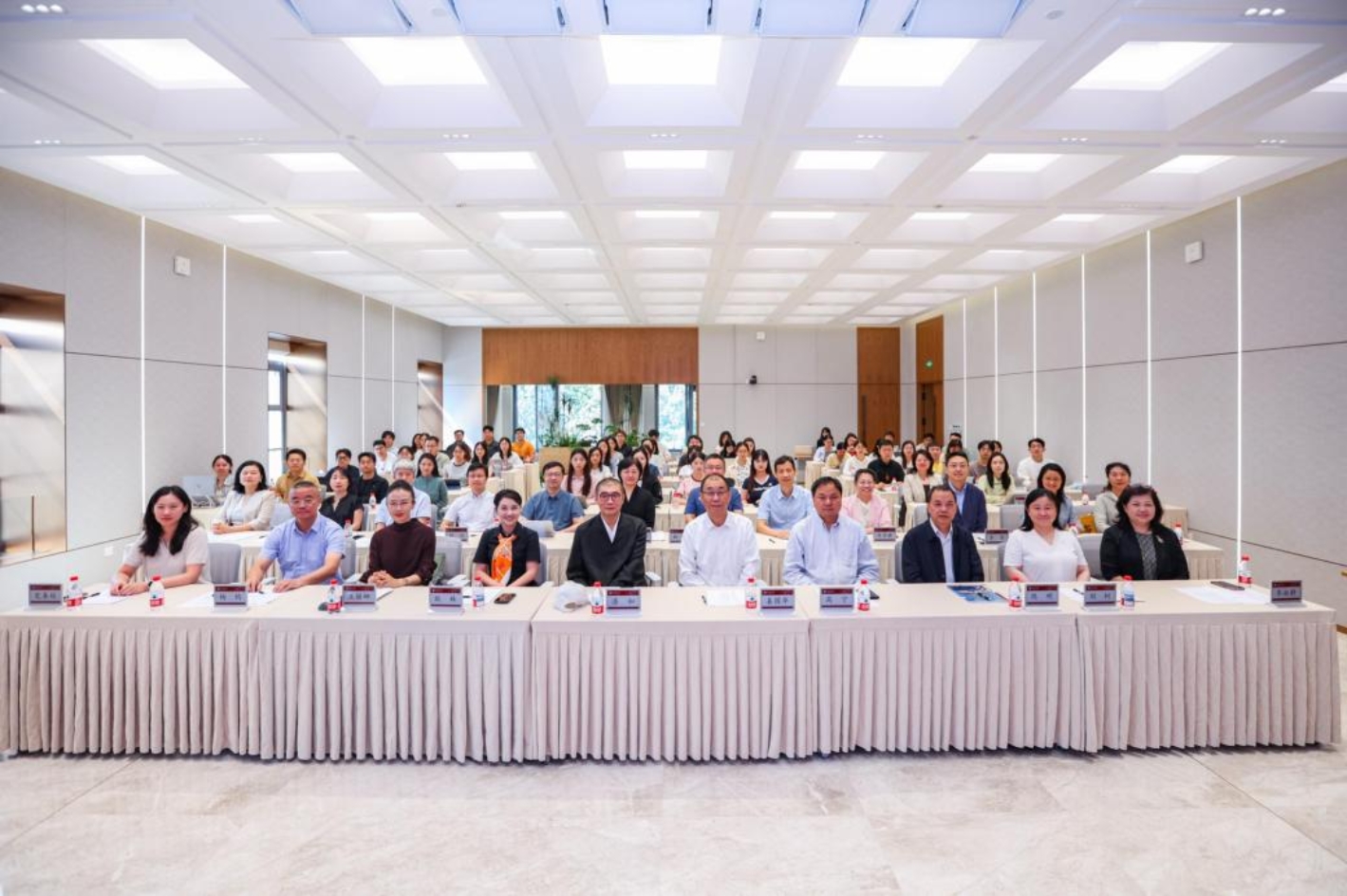
Participants pose for a group photo.
In his remarks, Jiang Guohua noted that Peking University has in recent years continued to advance the development of certificate programs, with a focus on building interdisciplinary and cross-field platforms for cultivating versatile talent. Centered on the in-depth integration of China’s fine traditional humanistic wisdom and modern psychology, the Certificate Program for Interdisciplinary Training in Humanities and Psychology represents an important initiative through which the University responds proactively to national strategic needs, leverages its strengths as a comprehensive university with a broad range of disciplines, and advances the comprehensive reform of graduate education. He encouraged students to draw deeply from the fertile ground of China’s fine traditional culture, broaden their academic horizons through interdisciplinary integration, and attach importance to the coordinated development of body and mind. He also urged them to continually hone their ability to learn, to think critically, and to put knowledge into practice, and to translate what they learn and reflect upon into concrete action in support of national development and social progress.
Gao Ning, Vice Dean of the Graduate School, expressed his gratitude to the Beijing Venustech Charity Foundation for its strong support of the program. He hoped the program would serve as an interdisciplinary learning platform through which students could expand the boundaries of their knowledge beyond their primary fields of study. As a university pilot program, it will also explore an innovative model of talent development characterized by cross-departmental collaboration, modular design, and a strong emphasis on practical training. The Graduate School will work with the participating schools and departments to ensure the effective implementation of course development, practical training, program supervision, and certification upon completion, while continually iterating on and improving the program’s training framework.
Yang Jun introduced the Beijing Venustech Charity Foundation’s founding vision and early practical achievements in supporting the integration of China’s fine traditional culture with modern psychology. He noted that the Foundation would continue to follow the program and use this collaboration as an opportunity to explore new pathways and approaches to collaborative talent development between charitable foundations and higher education institutions.
Zhan Ru, Professor at the School of Foreign Languages and Director of the Program, gave a detailed presentation on the program’s overall positioning, development objectives, and specific training model. In response to the national imperatives of building a strong cultural nation, a strong talent base, and a Healthy China, the program has established an integrated three-part training system comprising coursework, cutting-edge lectures, and practical training, with the aim of cultivating high-level versatile talent with solid interdisciplinary competence.
Following the launch ceremony, the first lecture in the program’s series of thematic lectures was held. Professor Su Yanjie of the School of Psychological and Cognitive Sciences served as the guest speaker, while Yao Xiang, Vice Dean of the same School, chaired the lecture. Under the theme “Individual Development from Exploration to Muturation” Professor Su offered a systematic account of the principal characteristics, key developmental tasks, and ways of responding to real-life challenges at different stages of individual psychological development. She also engaged in extensive interaction and discussion with the faculty and students present.
The Peking University Certificate Program for Interdisciplinary Training in Humanities and Psychology is a University-level interdisciplinary graduate program under the guidance of the Graduate School and jointly developed by multiple schools and departments. The program is supported by special funding from the Beijing Venustech Charity Foundation and is open to applications from full-time graduate students across the University. The first cohort of selected students come from 27 schools and departments at the main campus and the Peking University Health Science Center.
The program adopts a three-component training model comprising coursework, cutting-edge lectures, and practical training. Students are required to complete all program requirements and assessments within one and a half academic years. Upon review and approval, they will receive a university-level certificate of completion.
Looking ahead, the program will be grounded in the wisdom of China’s humanistic thought while integrating it with modern psychological science. It will continue to bring together high-quality resources in the humanities and psychology, explore a distinctive Peking University model of interdisciplinary graduate education, and cultivate versatile talents who are culturally grounded, knowledgeable in science, capable in practice, and ready to shoulder responsibility. Through these efforts, the program will contribute Peking University’s strength to the development of philosophy and the social sciences with Chinese characteristics, the improvement of China’s national system of social psychological services, and the advancement of the Healthy China initiative.
Translated by Gong Zhenning