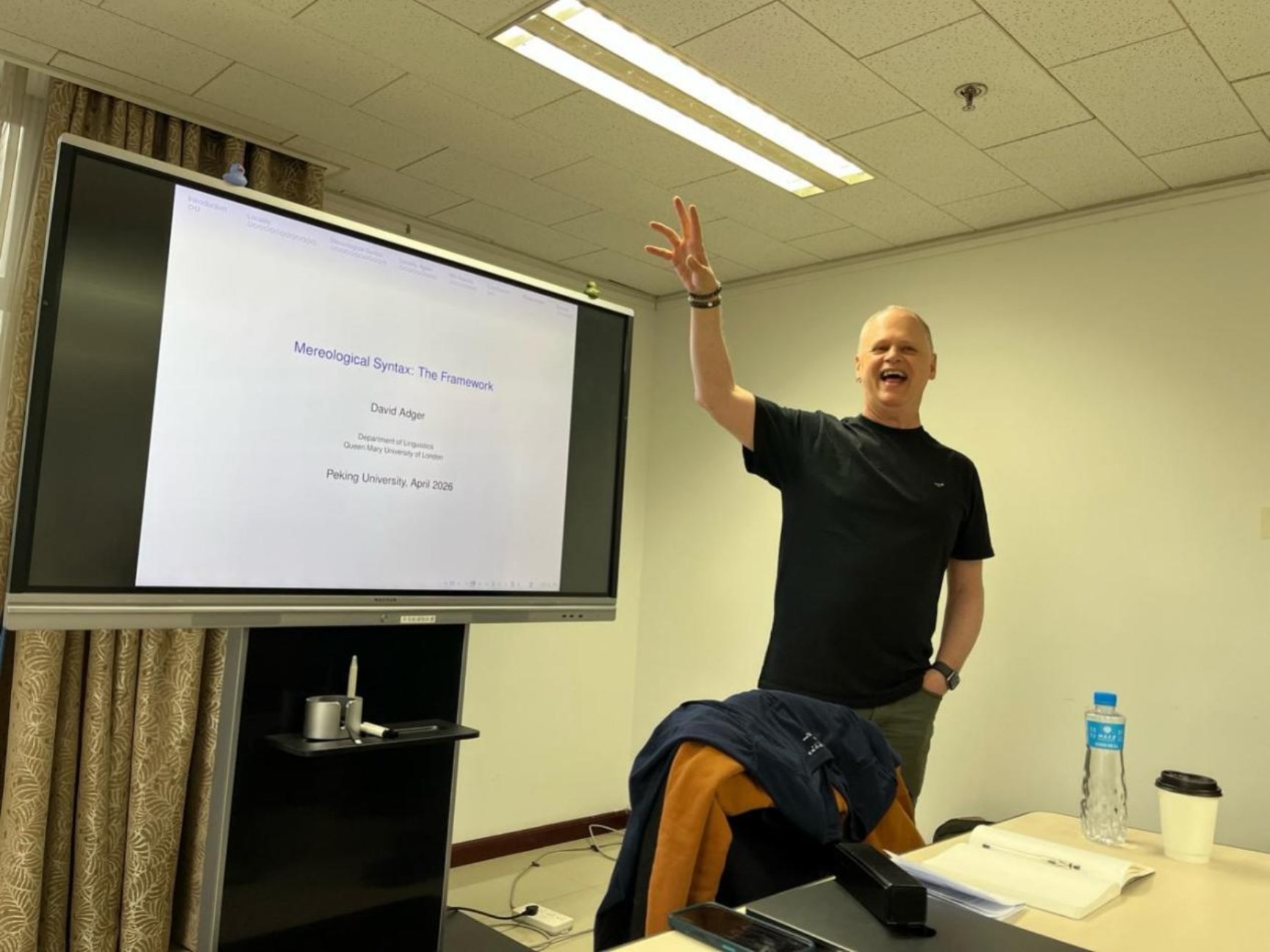
On the afternoon of April 9, 2026, the 468th Peking University Humanities Lecture was held in Room 401 of the New Building, School of Foreign Languages, Peking University. David Adger, Professor of Linguistics at Queen Mary University of London, was invited to deliver a talk entitled Mereological Syntax: The Framework. A world-renowned theoretical linguist, Professor Adger is a Fellow of the British Academy and a former President of the Linguistics Association of Great Britain. He has authored numerous monographs with Oxford University Press, Cambridge University Press and MIT Press, and has published dozens of articles in top-tier journals including Linguistic Inquiry, Language and Journal of Linguistics, as well as in edited academic collections.
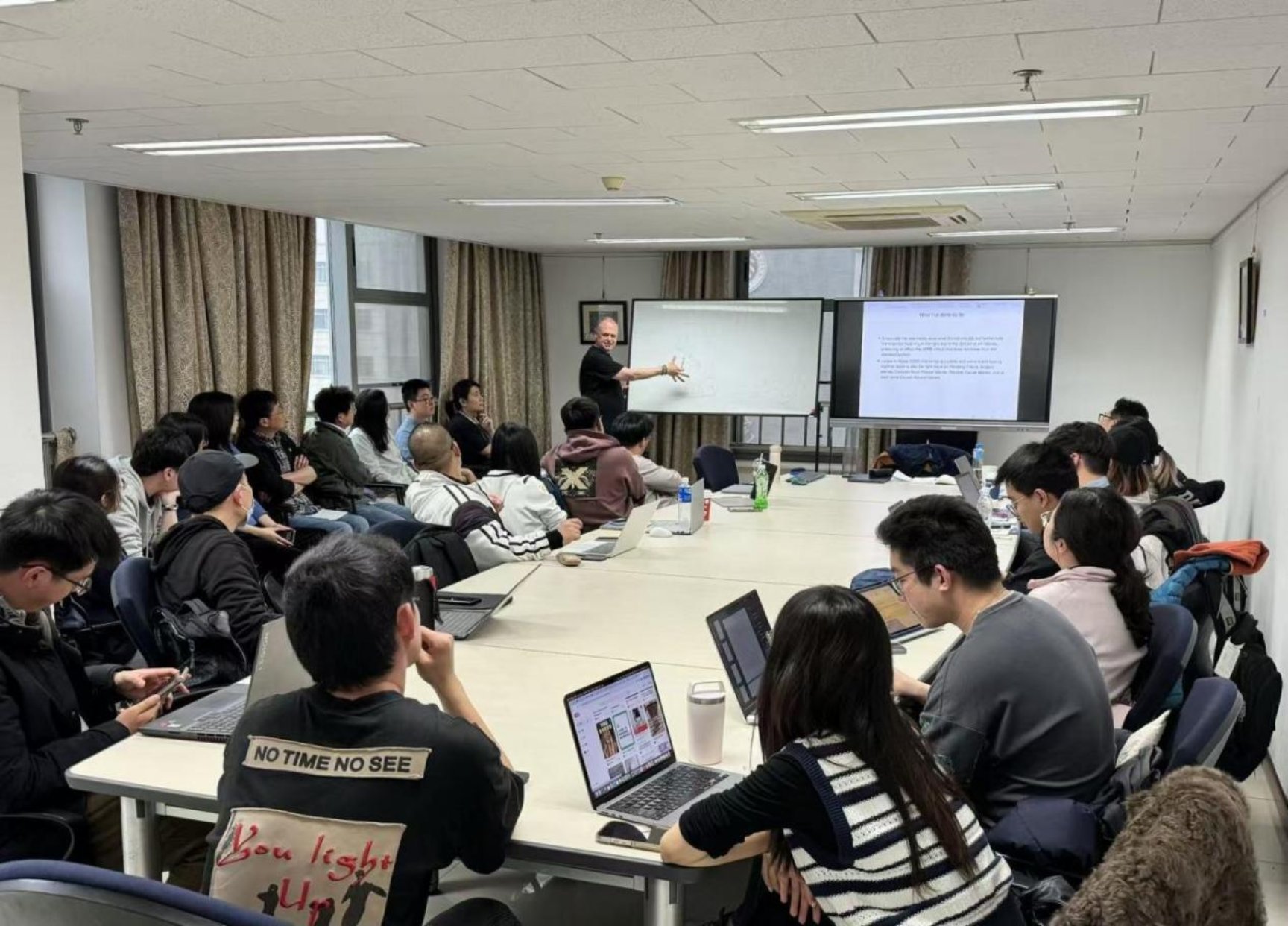
This lecture is part of the “Linguistics and Applied Linguistics” Lecture Series, co-organized by the Institute of Linguistics and Applied Linguistics, School of Foreign Languages, and the Faculty of Humanities, Peking University. The event was chaired by Hu Xuhui, tenured Associate Professor and Director of the Institute of Linguistics and Applied Linguistics. This talk drew a diverse audience, including faculty members and students from Peking University, Tsinghua University, and Beijing Language and Culture University.
During the lecture, Professor Adger systematically elaborated on the innovative theoretical framework established in his new monograph “Mereological Syntax: Phrase Structure, Cyclicity, and Islands (MIT Press).” He argued for replacing the set-theoretic view of syntax in mainstream generative linguistics with mereology, a theoretical approach grounded in part-whole relations. Professor Adger introduced the operation of “Subjoin” to replace the mainstream “Merge” operation, framing syntactic structure as a hierarchical system formed by parts and wholes, offering new insights into the fundamental principles governing syntactic structures. Professor Adger also explained how this new framework could address core theoretical challenges in the Minimalist Program, including labeling and copy problems, and provided a unified account for classic syntactic phenomena such as movement, phase effects and island effects. The lecture not only presented Professor Adger’s cutting-edge research, but also reviewed canonical theories of mainstream generative linguistics, offering the audience an academic experience that integrates theoretical foundations and frontier explorations.
In the discussion session, faculty and students had in-depth exchanges on the basic assumptions and core mechanisms of mereological syntax, as well as its connection to the classic theoretical framework of formal syntax. The audience raised questions on topics including the differences between subjoin operations across different dimensions and how labels/features could be formally represented under this framework. Professor Adger addressed each question with concrete linguistic data and case studies, and exchanged views with the audience on possible future research directions.
Written by Su Chuanshun, Zhang Zepu
Photos by Li Yingyi
Translated by Chen Xirong