
On March 14, 2026, the launch meeting of the Major Project of the National Social Science Fund of China, "Digital Collation and Research of Image Documents from Ancient World Civilizations," along with the inaugural symposium on world civilization images, was held at Room 208, Minzhu Building, Peking University. More than seventy experts and scholars from leading universities and academic institutions—including Peking University, Tsinghua University, the Chinese Academy of Social Sciences, Zhejiang University, Nanjing University, Sun Yat-sen University, the University of International Business and Economics, the University of Macau, Nanyang Technological University, the Bronze Ware Committee of the China Cultural Relics Academy, and the Jinzhiyuan Mural Museum—attended the meeting. The discussions focused on the digital collation of ancient world civilization image documents and the development of a digital research platform.
The opening ceremony was presided over by Lin Fengmin, Deputy Director of the Office of Humanities and Social Sciences and Deputy Director of the Office of Academic Discipline Development, Peking University. Chu Xiaobo, Director of the Office of Humanities and Social Sciences at Peking University, delivered a speech emphasizing that the project, with its global vision and interdisciplinary approach, draws on both Chinese and international scholarship, excavates historical resources, and addresses contemporary concerns. He noted that the project fully embodies Chinese characteristics, Chinese style, and Chinese presence, carrying significant academic and practical value.
Following the opening ceremony, the project team delivered their reports. Chen Ming, Dean of the School of Foreign Languages at Peking University and the project's principal investigator, presented the overall project plan. Sub-project principal investigators—Su Qi (Tenured Associate Professor, School of Foreign Languages, Peking University), Ding Li (Professor, School of Foreign Languages, Peking University), Wu Weilin (Associate Professor, School of Foreign Languages, Sun Yat-sen University), Jia Fei (Associate Professor, School of Foreign Languages, University of International Business and Economics), and Liu Hongbo (Professor, School of Foreign Languages, Peking University)—reported on the division of labor, research objectives, and expected outcomes of their respective sub-projects: "Construction of a Digital Resource Platform for Image Documents from Ancient World Civilizations," "Digital Collation and Research of Image Documents from China and Neighboring Civilizations (East Asia, Southeast Asia)," "Digital Collation and Research of Image Documents from South Asian Civilizations," "Digital Collation and Research of Image Documents from West Asian and African Civilizations," and "Digital Collation and Research of Image Documents from European and American Civilizations." Subsequently, Ren Baomin, Academic Director of the Jinzhiyuan Mural Museum, introduced the technical framework for constructing the "Digital Repository of Ancient Chinese Murals," providing an important reference for the project's digital resource development.
The expert review session was chaired by Zhao Xianzhang, Professor of the Department of Chinese Language and Literature at Nanjing University and head of the expert panel. Experts including Hong Huaqing, Li Jun, Li Song, Xie Jisheng, and Zhu Qingsheng delivered remarks. They highly commended the project's forward-looking significance in focusing on image documents, addressing ancient world civilizations, and leveraging digital technology to empower humanities research. They noted that the project demonstrates a broad global perspective and a sharp sense of critical inquiry, which will not only deepen the study of ancient world civilizations but also provide vital support for interdisciplinary innovation and the construction of an independent knowledge system. The experts also offered targeted suggestions regarding digitization standards, cross-database data alignment, selection of typical case studies, and the public accessibility of the database. Chen Ming, the principal investigator, responded to the comments and affirmed that the team would fully consider the experts' advice to further refine the project implementation plan.
The afternoon session, the "Inaugural Symposium on World Civilization Images," was divided into three panels. The first panel, chaired by Su Qi with commentary by Li Song, featured a report by Liang Jian (Deputy Director of the Bronze Ware Committee, China Cultural Relics Academy) and Ren Chao (cultural relic photographer) titled "New Discoveries from the Inspection of the Yingxian Wooden Pagoda." The second panel, chaired by Ding Li with commentary by Xie Jisheng, featured a report by Tan Shengguang (Chief Curator of the Tsinghua University Art Museum) titled "The Way of Bamboo: Revisiting Zhang Qian's Encounter in Daxia and Early Exchanges between Eastern and Western Civilizations." The third panel, chaired by Wu Weilin with commentary by Li Jun, featured a report by Chu Xiaoxing (scholar and collector of ancient Chinese calligraphy, painting, and porcelain) titled "What Serves as a Vessel? Explorations of a Global Narrative for Chinese Art History."
The roundtable discussion was chaired by Jia Fei, during which participating scholars engaged in thorough discussions on the conceptual connotation of "world civilization images" and the pathways for building the digital platform. The closing ceremony was chaired by Liu Hongbo, with concluding remarks delivered by Zhao Xianzhang, Hong Huaqing, and Chen Ming, summarizing the academic achievements and key discussions of the meeting. The meeting not only deepened understanding of the research subjects, approaches, and methods related to ancient world civilization image documents but also highlighted the significant value of digital technology in empowering humanities research and promoting comparative and inter-civilizational exchanges. It laid a solid foundation for advancing systematic research on ancient world civilizations, expanding the academic boundaries of digital humanities, and establishing a paradigm for world civilization studies from a Chinese perspective.
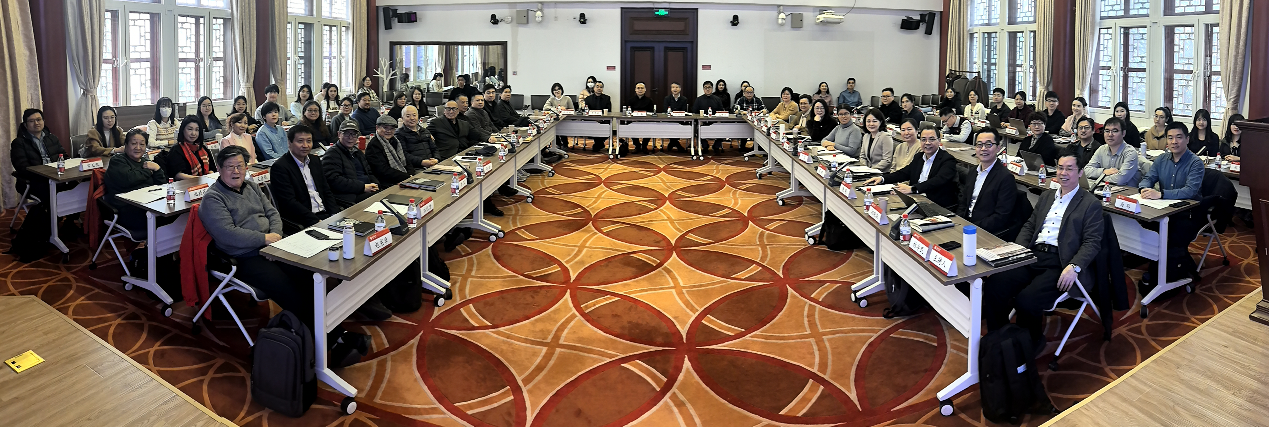
Group photo of participating scholars
Text: Dong Guanlin / Photos: Shi Yang
Translated by Zou Ya