On November 22, 2025, the 3rd International Symposium on "Methods of East Asian Classical Studies" was successfully held at Peking University (PKU). This symposium was hosted by Research Center for Eastern Literature and the Department of Japanese Language and Culture of the School of Foreign Languages at PKU, co-organized by the Graduate School of Humanities and Sociology and Faculty of Letters of the University of Tokyo, and supported by the Journal of Japanese Language Study and Research.
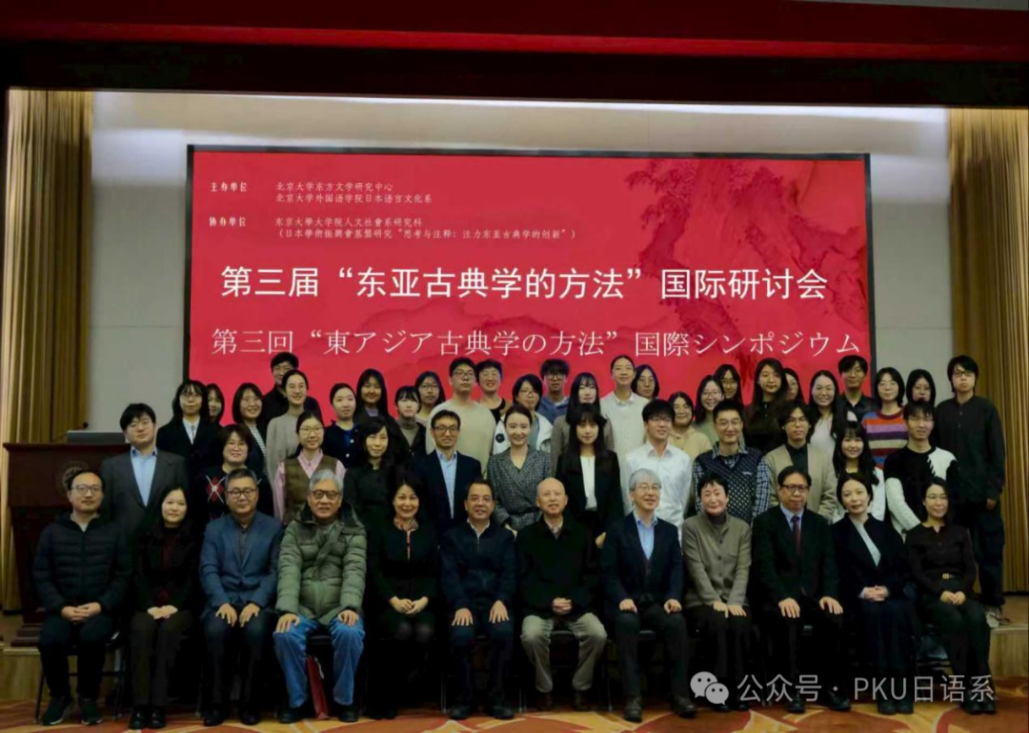
With the core theme of "Continuity and Breakthrough of Classical Studies Methods in the New Context," this conference aimed to respond to the growing interdisciplinary demands in East Asian classical studies and research. Focusing on the interactive relationships among multiple dimensions such as texts and annotations, texts and images, literature and thought, the conference inquired into how to re-examine the value of classics and explore the potential of their theoretical paradigms and practical approaches in the context of a new era. Experts and scholars from PKU, Tsinghua University, Renmin University of China, Beijing Foreign Studies University, Capital Normal University, China Foreign Affairs University, Nankai University, Nanjing University, Central China Normal University, Anhui Agricultural University, as well as the University of Tokyo, Kyoto University, Meiji University, and Hokkaido University in Japan gathered at PKU to participate in and celebrate this academic event.
The opening ceremony was presided over by Professor Ding Li of PKU. In his speech, Professor Chen Ming, Dean of the School of Foreign Languages and Director of Research Center for Eastern Literature of PKU, used the metaphor of "blind men touching an elephant"—a Chinese idiom indicating to draw a conclusion on the basis of partial understanding—to point out that East Asian classical civilization is a vast organic whole, and a single discipline can often only glimpse a part of it. He advocated that today’s classical studies should engage in a global history perspective and to extend their reach to broader fields such as historical materials involving images, books, and cultures.
The symposium was divided into four sessions, in which Chinese and Japanese scholars engaged in in-depth exchanges and discussions around their latest research findings, demonstrating a combination of empirical textual research and theoretical reflection. The first session, centering on the core issue of textual verification and knowledge reconstruction, was chaired by Professor Liu Yuzhen of Nankai University, and focused on the exegetical verification of classical texts and the localized reconstruction of foreign knowledge. The second session, with the main topic of the evolution of canonical texts and implicit authority, was chaired by Associate Professor Zhou Yiliang of Capital Normal University, and explored the transnational circulation of canonical texts in East Asia and the construction of authority. The third session, chaired by Professor Li Mingjing of Renmin University of China, concentrated on narrative variation and plurality of thoughts, which explored the narrative logic in myths, legends, and monogatari literature. The fourth session, with the central topic of the politics of images and the practice of knowledge, was chaired by Associate Professor Gao Yang (tenured) of Tsinghua University, and addressed the social and political functions behind visual arts and medical knowledge.
The roundtable discussion and closing ceremony were presided over by Professor Saito Mareshi and Professor Ding Li. During the roundtable session, in addition to in-depth exchanges among participating experts, special attention was given to reports from the doctoral academic workshop. Five young scholars from PKU and the University of Tokyo presented around cutting-edge topics including "New-Chinese-style Japanese," "Medieval Epidemic Narratives," and "Comparative Literature between Chinese and Japanese." Professor Wu Qian from the Historiographical Institute of the University of Tokyo noted that the research of young scholars demonstrates how language serves as a device for cultural reconstruction, transcending national borders to create new worlds; such focus on "humanity" is precisely the unique value of humanities disciplines in the AI era.
In his concluding remarks, Professor Saito Mareshi used the metaphor of "blossoming flowers" to fondly review the development of the symposium. He believed that after three years’ cultivation, this academic exchange platform has evolved from its initial "exploration phase" into a "maturity phase." Chinese and Japanese scholars are no longer limited to one-way knowledge transmission but have formed genuine two-way dialogue and fusion of perspectives. This sincere exchange across generations and borders is a testament to the flourishing of academic blossoms.
Professor Ding Li of PKU delivered the closing speech on behalf of the organizers. She thanked all participating scholars for their contributions and particularly emphasized the significance of this conference in nurturing young research forces. She stated that the exploration of methodological approaches in East Asian classical studies is a continuous process and expressed the hope that more scholars will join this dialogue in the future to jointly promote the construction of research paradigms of contemporary relevance and regional depth.
Text and photos by Department of Japanese Language and Culture
Translated by Qu Sizhe